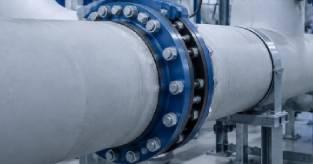
Choosing flanges for data center cooling systems starts with the water. Four types of water run through one building, each with its own chemistry, and the chloride level in each decides which grade lasts and which pits. Standards, flange types, pressure class, passivation and leak control follow from that decision.
Guru Gautam provides immediate inventory availability for cooling packages, maintaining a comprehensive stock of pipes, tubes, and pipe fittings across diverse grades and sizes. As a flange supplier for data center projects we ship with an EN 10204 3.1 certificate for flanges.
The Four Waters and What Each One Does to Metal
Liquid cooling pipework splits the water into separate circuits, and the chemistry differs in each.
Chilled water in a closed loop is treated and dosed, so chlorides stay controlled while the treatment regime holds. That is the easiest duty in the building, and chilled water pipe flanges on the mains are the largest on site.
Condenser water is the hardest. An open circuit concentrates as it evaporates, chlorides climb, and fouling adds microbiologically influenced corrosion on top. Cooling tower pipe flanges are where stainless earns its cost.
Facility water sits between them. The facility water system feeds the hall and reaches the coolant distribution unit carrying what the make-up water brought.
Technology cooling system fluid is not plain water. A CDU creates an isolated secondary loop, controls its pressure, temperature, flow and filtration, and holds the supply above dew point. That fluid reaches cold plate microchannels, which block on particles, so CDU flange connections get reopened more than any other.
PG25 and the Technology Cooling System Fluid
PG25 is nominally 25% propylene glycol with high-purity water and a corrosion inhibitor package, the common single-phase heat transfer fluid in direct-to-chip loops.
Open Compute Project guidance and coolant datasheets list 304L, 316L or higher grades as acceptable wetted materials for PG25-class fluids, with corrosion testing to ASTM D8040, and advise avoiding Hastelloy B.
One point gets reported the wrong way round. SS 316L flanges for liquid cooling became the standard technology cooling system choice for chloride tolerance in make-up water, not for the glycol, which suits both austenitic grades. Send the wetted materials list to the coolant supplier first.
Grade Selection Against Water Chemistry
Six grades cover the work, and chloride tolerance decides between them.
Grade
Where it suits
Chloride tolerance
SS 304 / 304L (ASTM A182 F304L)
Treated closed-loop chilled water
Low
SS 316 / 316L (ASTM A182 F316L)
Coolant-wetted service, facility water, TCS
Moderate
Duplex 2205 (UNS S31803, S32205)
Condenser water, raised chlorides
High
Super duplex 2507 (UNS S32750)
Coastal sites, concentrated circuits
Very high
Cupro-nickel 90/10
Seawater and brackish heat rejection
High in seawater
Titanium Grade 2
Seawater heat exchangers
Very high
Treated closed-loop chilled water with a managed inhibitor package is the service 304L was made for, and the low carbon variant keeps carbide precipitation down after welding.
Molybdenum separates the two austenitic grades, lifting chloride pitting resistance enough to carry facility water and technology cooling service. That makes 316 and 316L the working stainless steel flanges for data centers, and stainless steel 316 flanges the grade to price first on coolant-wetted lines.
Condenser water concentrates, and at some point 316L stops being comfortable. Duplex steel flanges answer with roughly double the yield strength and a higher PREN. Super duplex 2507 extends the argument to coastal sites.
Seawater sites move outside the stainless range. Monel 400 flanges, Inconel 625, 90/10 cupro-nickel and titanium Grade 2 appear on heat rejection circuits, selected against the specific water.
Galvanic Corrosion and Mixed-Metal Loops
A liquid cooling loop mixes metals by design. Copper cold plates, aluminium and stainless share one fluid path, and a circuit between dissimilar metals in a conductive fluid drives galvanic corrosion at the junction.
Dissimilar metal flange isolation breaks that circuit: an isolating gasket, a full-length sleeve on every bolt, and washers at both ends, with G10, G11 and G7 retainers.
Gasket Material Against the Fluid
Gasket selection follows grade selection. The fluid decides.
EPDM is the default for water and glycol-water service: full face on flat-face joints, ring on raised face. Confirm the elastomer against the coolant datasheet before the order goes out.
EPDM covers the whole temperature range these loops run at. ASHRAE's warmest class starts above 45 °C and OCP names 17 °C to 66 °C as typical technology cooling service, while EPDM is rated to roughly 110 °C to 150 °C depending on compound, so warm-water returns and heat recovery loops stay inside it. Move to spiral wound only where temperature, pressure or media pass what an elastomer will take, and check the bolt load first: a spiral wound gasket needs far higher seating stress than EPDM to seal at all.
Matching Grade to Loop and Line Size
With the chemistry settled, the grades map onto the circuits.
Cooling loop
Line size
Usual grade
Chilled water headers and risers
200 to 900 NB
Carbon steel or 304L
Chilled water branch to CRAH
50 to 150 NB
SS 304L
Condenser water and cooling tower
150 to 600 NB
316L or duplex 2205
Facility water branch to CDU
50 to 200 NB
SS 316L
TCS inside the CDU skid
25 to 100 NB
SS 316L
Make-up water and drain lines
15 to 50 NB
304L or 316L
Roughly 90% of a GB300 NVL72 rack's heat goes to liquid and about 10% leaves by air, keeping CRAH coil flange connections on the drawing at 50 NB to 150 NB. Liquid cooling manifold flanges sit at pumps and skid boundaries.
Rack power explains the rising connection count. Air cooling handles roughly 30 to 40 kW per rack, and direct-to-chip extends that to 60 to 120 kW. Published rack figures for the GB300 NVL72 sit between 132 kW and 142 kW nominal, with a peak near 155 kW. ASHRAE TC 9.9 sets facility water classes from W17 at 2 to 17 °C to W+ above 45 °C, with convergence around 32 °C per Uptime Institute.
Standards and Drilling for Each Grade
Grade and standard are separate decisions. Line size selects the standard for flanges for data center cooling systems.
ASME B16.5 flanges cover NPS 1/2 to NPS 24 in Classes 150 to 2500, forged to ASTM A182. Cooling work stays in Class 150 and Class 300, and NPS 24 is the ceiling.
Above it, ASME B16.47 large diameter flanges cover NPS 26 to NPS 60. Series A carries the MSS SP-44 lineage and Series B the API 605 lineage, and the two do not bolt together. Series A is heavier and thicker at the same size and class, with a larger bolt circle and fewer, larger bolts. Series B is lighter and more compact, with a smaller bolt circle and more, smaller bolts. At NPS 30 Class 150, Series A has 28 bolt holes on a 36.00 in bolt circle against Series B's 44 holes on a 33.31 in circle. The two never mate, so the series has to be stated on the purchase order and confirmed against the counter-flange already installed.
AWWA C228 stainless steel flanges run 2 in to 72 in in 304L or 316L, pairing with carbon steel C207 from 4 in to 144 in. Both are rated in psi: SA 50, SB 86, SD 175 (150 psi at 14 in and larger), SE 275, SF 300. Classes SA to SE match the ASME B16.5 Class 150 bolt pattern up to NPS 24; from NPS 26 to NPS 60 they follow ASME B16.47 Series A drilling. C207 Class F and C228 Class SF use the Class 300 pattern. Above NPS 24, state the drilling basis explicitly on the order.
EN 1092-1 covers PN 2.5 to PN 400 in DN 10 to DN 4000, but cooling work sits in the PN 6 to PN 40 band, in Types 01 (plate), 02 (loose plate), 05 (blind) and 11 (weld neck). Legacy drawings still carry DIN 2576, which maps to Type 01. PN and Class never share a joint, and Indian projects often issue IS 6392 alongside BS 4504 drilling.
Flange Types in Each Grade
Every grade is available across the type range, and type is chosen on duty, not material.
Flange type
Best use in a cooling system
Weld neck
Main headers, risers, pump discharge
Slip-on
Class 150 chilled and condenser water runs
Blind
Capped tap-offs, test and flush points
Lap joint with stub end
Long stainless headers, bolt alignment
Socket weld
15 NB to 50 NB drains, vents, tappings
Threaded
Small bore gauge, sensor points
Orifice
Flow metering per CDU or zone
Flange adaptor
Grooved rooms meeting flanged plant
The lap joint type bears directly on material cost. Only the stub end touches the water, so only it has to be the specified alloy. On long stainless headers, lap joint flanges and stub ends hold the alloy spend there and let bolt holes rotate into line during fit-up.
On main headers, weld neck flanges take thermal cycling and vibration through the tapered hub. Across Class 150 runs, slip-on flanges keep fabrication costs down. Socket weld flanges for small bore lines serve drains and tappings, and a flange adaptor for grooved piping meets flanged equipment.
Capped Provision and Flow Metering
Open Compute Project guidance recommends preserving pipe paths and tap-off points to the facility water system, so liquid cooling can be added later. Blind flanges for capped tap-off points hold that provision open.
Where flow per CDU is metered for thermal commissioning and PUE reporting, orifice flanges carry the plate and tappings as one assembly.
Pressure Class and Face Selection
On Class 150 vs Class 300 flanges, specify Class 150 for standard chilled water duty, and Class 300 on tall risers where static head plus pump head plus surge passes the rating. Rate against design pressure.
On raised face vs flat face flange selection, raised face is the ASME B16.5 default at 1.6 mm (1/16 in). Use flat face wherever a steel flange bolts to a flat-faced cast iron pump or valve. The error persists because the parts fit: ASME B16.1 Class 125 drilling matches ASME B16.5 Class 150 steel drilling, so the bolts line up and the joint looks right. ASME B31.1 gives one remedy in two parts. Where a flat-faced cast iron flange meets a steel flange, remove the raised face from the steel flange and fit a full-face gasket. The full-face gasket is the part that matters: a ring gasket leaves an unsupported gap inside the bolt circle, and the brittle cast iron flange bends into that gap and cracks as the bolts are tightened. Specifying flat-face steel flanges from the start avoids the rework.
Protecting the Grade: Welding, Pickling and Passivation
A chemistry-led specification can still be undone during fabrication. Specifying 316L is wasted money if the weld is left scaled.
Back-purge with argon and control heat input, because heat tint and free iron are where pitting starts once coolant is in the loop. ASTM A380 covers cleaning, descaling and passivation, and ASTM A967 passivation and verification. Pickling removes heat tint, and passivation restores the chromium oxide layer. Shed particles block cold plate microchannels, and flanged joints are the flush access points.
Keeping the Joint Dry
For flange leak prevention in data centers, Open Compute Project guidance recommends leak detection on threaded, flanged, crimped and fused connections, placed where severity risk is low.
Chilled water below dew point makes the pipe sweat, and a flange breaks the insulation line. Flange insulation for chilled water uses removable jackets that hold the vapour barrier while leaving bolts reachable. Match bolting to the flange. For 304/304L flanges use ASTM A193 Grade B8 studs with ASTM A194 Grade 8 nuts. For 316/316L flanges in chloride-bearing or coolant-wetted service use ASTM A193 Grade B8M studs with ASTM A194 Grade 8M nuts, because Grade B8 is Type 304 and Grade B8M is the molybdenum-bearing Type 316 that matches the flange. The flange bolt tightening sequence runs in four passes:
Cross pattern to roughly one third of the target torque.
Cross pattern to roughly two thirds of the target torque.
Cross pattern to full torque.
A final clockwise pass at full torque.
Bolted joints relax through the first thermal cycles, so re-torque after commissioning. Expansion joints absorb pipe movement before it reaches pumps and CDUs as nozzle load on cooling equipment flanges.
On flanged vs grooved pipe joints, grooved couplings install roughly three times faster than flanged and five times faster than welded. The flange side's limitation is inspection: it cannot be checked without pressurising the system.
Certification, Stock and Ordering
An EN 10204 3.1 mill test certificate is the minimum, carrying heat number, chemical analysis and mechanical properties, traceable to the marking on the flange rim. MSS SP-25 places the marking on the outside edge of the flange, never on the sealing face, so receiving inspection reads the rim stamp against the certificate. A 3.2 adds third-party endorsement. PMI confirms grade by analysis, IGC testing to ASTM A262 checks the stainless, and MSS SP-25 covers the marking.
Stainless packs away from carbon steel, because iron from strapping rusts in transit and seeds pitting once the loop is wet.
A complete flange specification checklist line reads: ASME B16.5, 200 NB, Class 150, weld neck, raised face, bore to Sch 10S, ASTM A182 F316L, EPDM ring gasket, ASTM A193 B8M studs with ASTM A194 Grade 8M nuts, EN 10204 3.1 with PMI, MSS SP-25, pickled and passivated.
Send the coolant datasheet with the line list.
Our Supply Scope for Data Center Cooling Projects
Guru Gautam holds thousands of tonnes of pipes, tubes and pipe fittings, and sourcing covers anything outside stock. We supply to ASME B16.5, ASME B16.47 Series A and B, AWWA C207 and C228, EN 1092-1, DIN and IS 6392, Class 150 to 2500 and PN 6 to PN 40, in ASTM A182 F304L, F316L, F321, F51, S32750 and A350 LF2. Loops carrying flanges for chilled water systems also need stainless steel pipe fittings in matching grades.
Frequently Asked Questions
Yes. Open Compute Project guidance and coolant datasheets list 304L, 316L or higher grades as acceptable wetted materials for PG25-class propylene glycol fluids. The preference tracks chloride tolerance in make-up water, not the glycol.
Welding leaves heat tint and free iron, and both become pitting initiation points once coolant is present. ASTM A380 covers cleaning and descaling, ASTM A967 passivation and verification.
Ready to enquire? Send standard and series, size, class, type and face, grade, certification level, quantity and delivery dates, with the coolant datasheet.